Getting Started
How Bitcoin Payments Work, Step by Step
A plain-language walkthrough of the bitcoin transaction process: how funds move, what confirmations mean, and what to expect as a U.S. business or individual.
When someone pays you in bitcoin, nothing physical changes hands and no bank approves the transfer. Instead, a message gets broadcast to a global network of computers, and those computers agree, collectively, that the funds have moved. The whole thing can settle in under an hour without a payment processor in the middle.
Here's what's actually happening at each stage.
What a bitcoin transaction is made of
Every bitcoin payment is a digitally signed instruction that says, in effect: "Move X amount from this address to that address." The sender's wallet software builds that instruction using a private key, a long string of characters that proves ownership of the funds without revealing the key itself.
Three fields matter most:
- Inputs: References to previous transactions where the sender received bitcoin. This is how the network knows they actually have funds to spend.
- Outputs: The recipient's address and the amount being sent. There's often a second output sending "change" back to the sender if the input amount exceeds what's being paid.
- Fee: Whatever is left over after inputs minus outputs goes to the miner or validator who processes the transaction. Higher fees get confirmed faster.
No account numbers. No routing numbers. Just cryptographic proof that you control certain funds and a signed instruction to move them.
How the transaction reaches the network
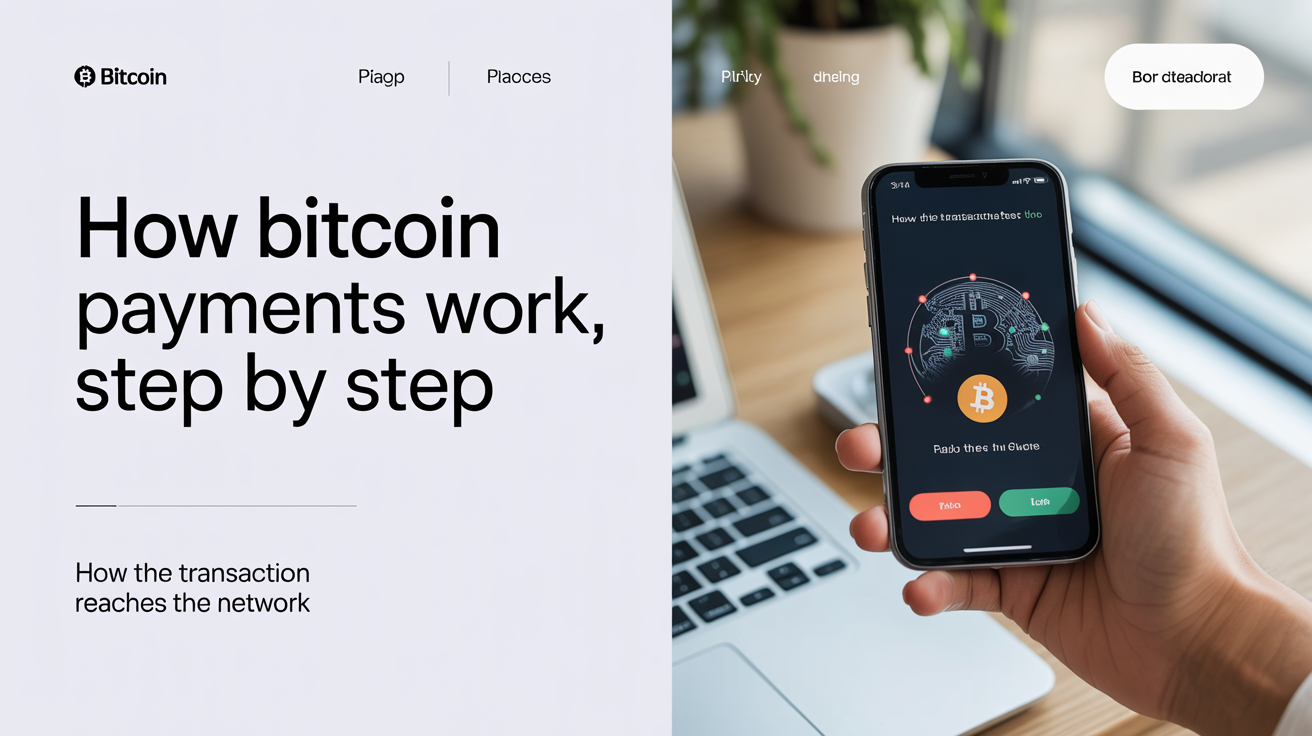
Once your wallet (or payment processor) constructs and signs the transaction, it broadcasts it to the Bitcoin network's peer-to-peer nodes. Within seconds, the transaction is visible to anyone watching the mempool, which functions as a waiting room for unconfirmed transactions.
At this point, the merchant can see the payment is on its way, but nothing is final yet. The funds are spoken for, not settled.
What confirmations actually mean
Miners (or in simplified terms, the computers doing validation work) bundle mempool transactions into blocks. Each block is added to a chain of previous blocks (hence "blockchain"). When your transaction lands in a block, it has one confirmation. Each subsequent block added on top adds another.
Why does this matter? A transaction can theoretically be reversed if someone controls enough of the network's computing power and builds a longer competing chain. The more confirmations a transaction has, the more work an attacker would have to redo to unwind it. In practice:
- 0 confirmations: The transaction exists in the mempool. Most merchants won't count this as final for any meaningful amount, but low-value point-of-sale purchases are sometimes accepted here.
- 1 confirmation: One block mined on top of the transaction. Takes roughly 10 minutes on average, though it can be faster or slower. Acceptable for many everyday purchases.
- 3–6 confirmations: Standard for higher-value transfers. Most exchanges and merchants requiring finality wait here.
For most U.S. businesses accepting bitcoin at a physical register, waiting for even one confirmation is often impractical. That's where Lightning comes in (more on that below).
On-chain vs. Lightning: two different payment rails
On-chain bitcoin transactions settle on the base layer described above. They're secure and final, but they're slow and the fees fluctuate based on network demand. During busy periods, a single transaction can cost several dollars in fees.
The Lightning Network is a second layer built on top of Bitcoin. It lets two parties open a payment channel, transact many times nearly instantly with negligible fees, and then settle the net result on-chain when they're done. For a coffee shop or an online store processing frequent small payments, Lightning is often the practical choice.
The tradeoff: Lightning requires channel liquidity and slightly more technical setup. If you're thinking through which rail fits your business, the guide at on-chain vs. Lightning goes through the real differences in detail.
What happens on the recipient's side
When you accept bitcoin as a business, you typically have two choices: hold the bitcoin yourself, or convert it to USD automatically through a payment processor.
Self-custody means the funds land in a wallet you control via your private keys. No intermediary can freeze or reverse the payment. The tradeoff is that you own the price exposure. If bitcoin drops 20% before you convert, you absorb that loss.
A processor like BTCPay Server, Strike, or OpenNode (to name broad categories, not endorsements) converts incoming bitcoin to dollars, usually at the moment of sale, and deposits USD to your bank account. You never technically hold bitcoin, which simplifies accounting and reduces price risk. The processor takes a small fee for this service.
For a longer look at the full setup process, this beginner's guide to accepting bitcoin in the U.S. covers the practical steps.
How addresses and wallets fit in
Before getting to taxes, it helps to understand what a bitcoin address actually is.
An address is a string of letters and numbers, typically starting with 1, 3, or bc1, that others can use to send you funds. You can generate as many addresses as you want from a single wallet. Most modern wallets do this automatically, giving you a fresh address for every incoming transaction. Reusing the same address lets anyone trace your full payment history on the public blockchain, so this is good practice for privacy.
Your wallet doesn't "store" bitcoin the way a bank account stores money. It stores the private keys that let you authorize outgoing transactions. The bitcoin itself exists as entries on the blockchain. If you lose access to your keys and have no backup, those funds are gone. There's no password reset, no customer service line. Self-custody requires taking that responsibility seriously.
For businesses considering whether to go the custody route or outsource it to a processor, the article on what it really means to accept bitcoin as payment works through the practical implications.
U.S. tax and recordkeeping basics
The IRS treats bitcoin as property, not currency. That means every transaction (receiving payment, converting to USD, even spending bitcoin on a business expense) is potentially a taxable event.
When you receive bitcoin as payment for goods or services, the fair market value in USD at the time of receipt is ordinary income. If you later sell or convert that bitcoin, any difference between what you recorded as income and the sale price is a capital gain or loss.
What you need to track for each transaction:
- Date and time
- Amount of bitcoin received or sent
- USD fair market value at that moment
- The nature of the transaction (sale, purchase, conversion)
FinCEN also has reporting requirements for certain business-side activity, particularly if you're transmitting money on behalf of others. This article is educational and doesn't cover every scenario. Confirm your specific obligations with a CPA or tax attorney who works with digital assets. Rules change, and state-level requirements vary.
FAQ
How long does a bitcoin payment take to confirm? The first confirmation takes about 10 minutes on average, but that varies. If the fee attached to the transaction is low relative to current network demand, it can sit in the mempool for much longer. Lightning Network payments confirm in seconds.
Can a bitcoin payment be reversed? Not after enough confirmations. There's no chargeback mechanism. This is appealing to merchants who deal with fraud, but it also means that if you send bitcoin to the wrong address, there's no way to claw it back.
Do I need a business bank account to accept bitcoin? Not to receive bitcoin directly. But if you use a processor that converts to USD, you'll need somewhere to deposit dollars, and most processors require a verified business account. Self-custody wallets have no such requirement.
What does the bitcoin transaction fee pay for? The fee compensates miners for including your transaction in a block. There's no fixed rate. Wallets estimate fees based on current mempool congestion. You can usually choose between faster (higher fee) and slower (lower fee) settlement.
Is accepting bitcoin legal for U.S. businesses? Yes, generally. Businesses can accept bitcoin as payment without a money transmitter license as long as they're receiving it in exchange for goods or services, not transmitting it on behalf of customers. That said, state laws differ, and if your model involves holding or moving funds for others, licensing questions get more complex. Get qualified legal advice before assuming you're outside regulatory scope.
Accept Bitcoin USA is an independent educational resource. Nothing here is financial, tax, or legal advice. Confirm current IRS, FinCEN, and state requirements with qualified professionals before acting.